Tuesday, March 18, 2014

Wasp


Wasp
Wasp is a insect that venomous than hornet which is in January's addition. It's eat house fly and even slug. They are very small but it can bring dead even human beings.


Taxonomy

The suborder Symphyta, known commonly as sawflies, differ from members of Apocrita by lacking a sting, and having a broader connection between the mesosoma and metasoma. In addition to this, Symphyta larvae are mostlyherbivorous and "caterpillarlike", whereas those of Apocrita are largely predatory.


Characteristics


  • Nearly all wasps are terrestrial; only a few specialized parasitic groups are aquatic.
  • Predators or parasitoids, mostly on other terrestrial insects; most species of Pompilidae (e.g.tarantula hawks), specialize in using spiders as prey, and various parasitic wasps use spiders or other arachnids as reproductive hosts.
  • A pair of talons.

Anatomy

It is possible to distinguish between sexes of some wasp species based on the number of divisions on their antennae. For example, male yellowjacket wasps have 13 divisions per antenna, while females have 12. Males can in some cases be differentiated from females by virtue of having an additional visible segment in the metasoma.


PREY AND ENEMIES

prey

enemies


SAVE ANIMALS
It's super-easy to help animals, no matter how old you are. Check out how Save Animals to get a jump-start on making a huge difference in the lives of animal everywhere: Animals are alive for their own reasons, not to entertain us. Animals in movies, circuses, and zoos are denied everything that is natural and important to them. They will never be allowed to hang out with their families, graze, or do anything that they would do in the wild. Refuse to support this cruelty by never going to a zoo, marine park, or circus that uses animals. If your class is planning on dissecting any animal, ask your teacher for a humane alternative assignment, such as using a computer program to perform a virtual dissection. An animal will be saved, and you will actually learn and remember way more! Check out more info on how to get a dissection alternative at your school.

 THE END
THANK YOU


Friday, March 14, 2014

Mozambique spitting Cobra


Mozambique spitting Cobra
Mozambique spitting Cobra is a reptile. It spared venom to eyes of anyone. If the venom come to eyes , It will blind . This venom can go over 2 meters. It catches rats and frogs by it's bite. It live in Africa.


Distribution

 The distribution includes Natal,Mpumalanga Province Lowveld region , south-eastern Tanzania and Pemba Island and west to southern Angola and northern Namibia.


Toxicology

Like the Rinkhals, it can spit its venom. Its bite causes severe local tissue destruction (similar to that of the puff adder). Venom to the eyes can also cause impaired vision or blindness.


Habits

 By doing this the venom can be ejected at a distance of 2-3 metres (6½-10 feet), with remarkable accuracy. The spitting cobra does bite depending on its environment and the situation it is in, and also shares the same habit with theRinkhals of feigning death to avoid further molestation.


PREY AND ENEMIES


prey

enemies

SAVE ANIMALS
It's super-easy to help animals, no matter how old you are. Check out how Save Animals to get a jump-start on making a huge difference in the lives of animal everywhere: Animals are alive for their own reasons, not to entertain us. Animals in movies, circuses, and zoos are denied everything that is natural and important to them. They will never be allowed to hang out with their families, graze, or do anything that they would do in the wild. Refuse to support this cruelty by never going to a zoo, marine park, or circus that uses animals. If your class is planning on dissecting any animal, ask your teacher for a humane alternative assignment, such as using a computer program to perform a virtual dissection. An animal will be saved, and you will actually learn and remember way more! Check out more info on how to get a dissection alternative at your school.

 THE END
THANK YOU


Thursday, March 13, 2014

Jackass Penguin


Jackass Penguin
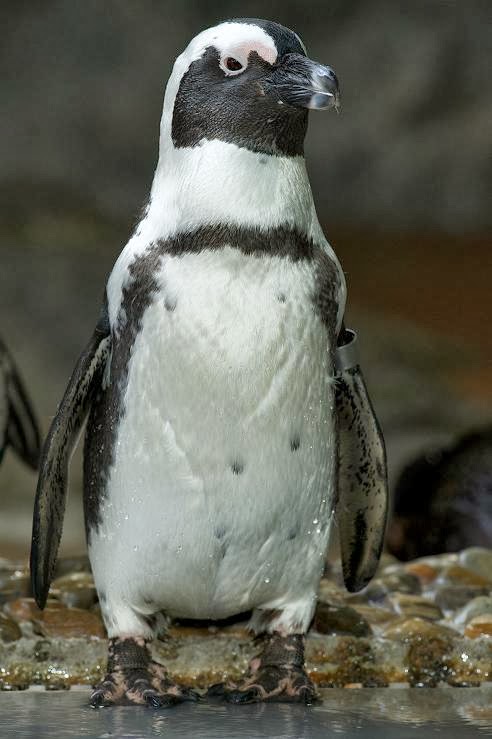
Jackass Penguin is a penguin that live in south Africa's beaches . It's speak like a donkey that's why it is called Jackass Penguin. It's eats fishes.


Etymology

Ancient Greek word sphen, which means wedge. This refers to their streamlined body shape. Its species name, demersus, is a Latin word for "plunging".


Distribution


Two colonies were established by penguins in the 1980s on the mainland near Cape Town, namely Boulders Beach near Simon's Town and Stony Point in Betty's Bay. Mainland colonies probably only became possible in recent times due to the reduction of predator numbers, although the Betty's Bay colony has been attacked byleopards.

Conservation

The oiled birds were brought to an abandoned train repair warehouse in Cape Town to be cared for. An additional 19,500 un-oiled penguins were removed from Dassen Island and other areas before they became oiled, and were released about 800 kilometres east of Cape Town, near Port Elizabeth.


PREY AND ENEMIES

prey

enemies

SAVE ANIMALS
It's super-easy to help animals, no matter how old you are. Check out how Save Animals to get a jump-start on making a huge difference in the lives of animal everywhere: Animals are alive for their own reasons, not to entertain us. Animals in movies, circuses, and zoos are denied everything that is natural and important to them. They will never be allowed to hang out with their families, graze, or do anything that they would do in the wild. Refuse to support this cruelty by never going to a zoo, marine park, or circus that uses animals. If your class is planning on dissecting any animal, ask your teacher for a humane alternative assignment, such as using a computer program to perform a virtual dissection. An animal will be saved, and you will actually learn and remember way more! Check out more info on how to get a dissection alternative at your school.

 THE END
THANK YOU


Sunday, March 9, 2014

Shoebill strock


Shoebill strock
Shoebill strock is a bird of prey . It eats fish , small birds and also prehistoric African lungfish . It has long legs.

Taxonomy and systematics

The dispute has turned out to be mainly one of where to draw the boundary between Ciconiiformes and Pelecaniformes, or whether to draw it at all. Sincecormorants and relatives are probably not actually Pelecaniformes, a solution adopted by some modern authors is to merge the "core" Pelecaniformes with the Ciconiiformes. 


Distribution and habitat

More isolated records have been reported of Shoebills in Kenya, theCentral African Republic, northern Cameroon, southwestern EthiopiaMalawi. Vagrant strays to the Okavango BasinBotswana and the upper Congo River have also been sighted. The distribution of this species seem to largely coincide with that of papyrus and lungfish.


Behavior and ecology

Shoebills are largely piscivorous but are assured predators of a considerable range of wetland vertebrates. Preferred prey species have reportedly included Marbled lungfish (Protopterus aethiopicus) and Senegal Bichir (Polypterus senegalus) as well as various Tilapia species and catfish, the latter mainly in the genus Clarias. Other prey eaten by this species has includedfrogswater snakesNile monitors (Varanus niloticus) and baby crocodiles.

PREY AND ENEMIES

prey

enemies


SAVE ANIMALS
It's super-easy to help animals, no matter how old you are. Check out how Save Animals to get a jump-start on making a huge difference in the lives of animal everywhere: Animals are alive for their own reasons, not to entertain us. Animals in movies, circuses, and zoos are denied everything that is natural and important to them. They will never be allowed to hang out with their families, graze, or do anything that they would do in the wild. Refuse to support this cruelty by never going to a zoo, marine park, or circus that uses animals. If your class is planning on dissecting any animal, ask your teacher for a humane alternative assignment, such as using a computer program to perform a virtual dissection. An animal will be saved, and you will actually learn and remember way more! Check out more info on how to get a dissection alternative at your school.

 THE END
THANK YOU


Saturday, March 8, 2014

Leopard shark


Leopard shark
Leopard shark is also called Zebra shark . It found in west U.S.A. It eats fishes, claims. It has sharp teethes . 

Taxonomy and phylogeny

Despite M. felis being the senior synonym, an error in recording the dates of publication resulted in the widespread use of T. semifasciata as the leopard shark's scientific name. As a result of this long-standing error, Triakis semifasciata came to be recognized as the valid name (as a nomen protectum) and Mustelis felis was invalidated (as a nomen oblitum).


Biology and ecology

From birth, leopard sharks form large schools generally segregated by age and sex, which may intermingle with grey or brown smoothhounds (Mustelus californicus and M. henlei) or spiny dogfish (Squalus acanthias).


Feeding

The leopard shark captures prey by expanding its buccal cavity to create a suction force, which is facilitated by its labial cartilages swinging forward to form the mouth into a tube. Simultaneously, the shark protrudes its jaws forward to grip the prey between its teeth.


PREY AND ENEMIES

prey

enemies

SAVE ANIMALS
It's super-easy to help animals, no matter how old you are. Check out how Save Animals to get a jump-start on making a huge difference in the lives of animal everywhere: Animals are alive for their own reasons, not to entertain us. Animals in movies, circuses, and zoos are denied everything that is natural and important to them. They will never be allowed to hang out with their families, graze, or do anything that they would do in the wild. Refuse to support this cruelty by never going to a zoo, marine park, or circus that uses animals. If your class is planning on dissecting any animal, ask your teacher for a humane alternative assignment, such as using a computer program to perform a virtual dissection. An animal will be saved, and you will actually learn and remember way more! Check out more info on how to get a dissection alternative at your school.

 THE END
THANK YOU


Friday, March 7, 2014

Wolverine


Wolverine
Wolverine is belong to a group of animal mammals. It has sharp claws and teethes. It is carnivore . It's found in North America's and Russia's tundras and forests . It is a small bear.


Taxonomy

Within the Gulo genus, a clear separation occurs between twosubspecies: the Old World form Gulo gulo gulo and the New World form G. g. luscus. Some authors had described as many as four additional North American subspecies, including ones limited to Vancouver Island (G. g. vancouverensis) and the Kenai Peninsula in Alaska (G. g. katschemakensis). However, the most currently accepted taxonomy recognizes either the two continental subspecies or recognize G. gulo as a single Holarctic taxon


Physical characteristics

The adult wolverine is about the size of a medium dog, with a length usually ranging from 65–107 cm (26–42 in), a tail of 17–26 cm (6.7–10.2 in), and a weight of 9–25 kg (20–55 lb), though exceptionally large males can weigh up to 32 kg (71 lb).


Behavior

Armed with powerful jaws, sharp claws, and a thick hide, wolverines, like most mustelids, are remarkably strong for their size. They may defend kills against larger or more numerous predators such as wolves or bears. At least one account reported a wolverine's apparent attempt to steal a kill from a black bear, although the bear won what was ultimately a fatal contest.


PREY AND ENEMIES

prey

enemies

SAVE ANIMALS
It's super-easy to help animals, no matter how old you are. Check out how Save Animals to get a jump-start on making a huge difference in the lives of animal everywhere: Animals are alive for their own reasons, not to entertain us. Animals in movies, circuses, and zoos are denied everything that is natural and important to them. They will never be allowed to hang out with their families, graze, or do anything that they would do in the wild. Refuse to support this cruelty by never going to a zoo, marine park, or circus that uses animals. If your class is planning on dissecting any animal, ask your teacher for a humane alternative assignment, such as using a computer program to perform a virtual dissection. An animal will be saved, and you will actually learn and remember way more! Check out more info on how to get a dissection alternative at your school.

 THE END
THANK YOU


Thursday, March 6, 2014

Greyhound dog


Greyhound dog
Greyhound dog is the European breed dog . It is the 6th fastest animal before Thomson guzzle , Antelope, foghorn, cheetah , Peregrine Falcon. It's speed is 89 km/h . Males weight - 27 to 40 kg female- 27 to 34 kg.

Anatomy

"Double suspension rotary gallop" describes the fastest running gait of the Greyhound in which all four feet are free from the ground in two phases, contracted and extended, during each full stride.


Roles of the breed

However, many breeders of racing Greyhounds argue that coursing is still important. This is the case particularly in Ireland, where many of the world’s leading breeders are based. A bloodline that has produced a champion on the live hare coursing field is often crossed with track lines in order to keep the early pace (e.g. speed over first 100 yards) that Greyhounds are renowned for prominent in the line.


Racing

Many Greyhounds enjoy success on the amateur race track. Organizations like the Large Gazehound Racing Association (LGRA) and the National Oval Track Racing Association (NOTRA) provide opportunities for Greyhounds and other sighthoundbreeds to compete in amateur racing events all over the United States


PREY AND ENEMIES

prey

enemies


SAVE ANIMALS
It's super-easy to help animals, no matter how old you are. Check out how Save Animals to get a jump-start on making a huge difference in the lives of animal everywhere: Animals are alive for their own reasons, not to entertain us. Animals in movies, circuses, and zoos are denied everything that is natural and important to them. They will never be allowed to hang out with their families, graze, or do anything that they would do in the wild. Refuse to support this cruelty by never going to a zoo, marine park, or circus that uses animals. If your class is planning on dissecting any animal, ask your teacher for a humane alternative assignment, such as using a computer program to perform a virtual dissection. An animal will be saved, and you will actually learn and remember way more! Check out more info on how to get a dissection alternative at your school.

 THE END
THANK YOU